

Continuous learning makes the difference: AI-literate testers safeguard quality where speed and automation fall short.
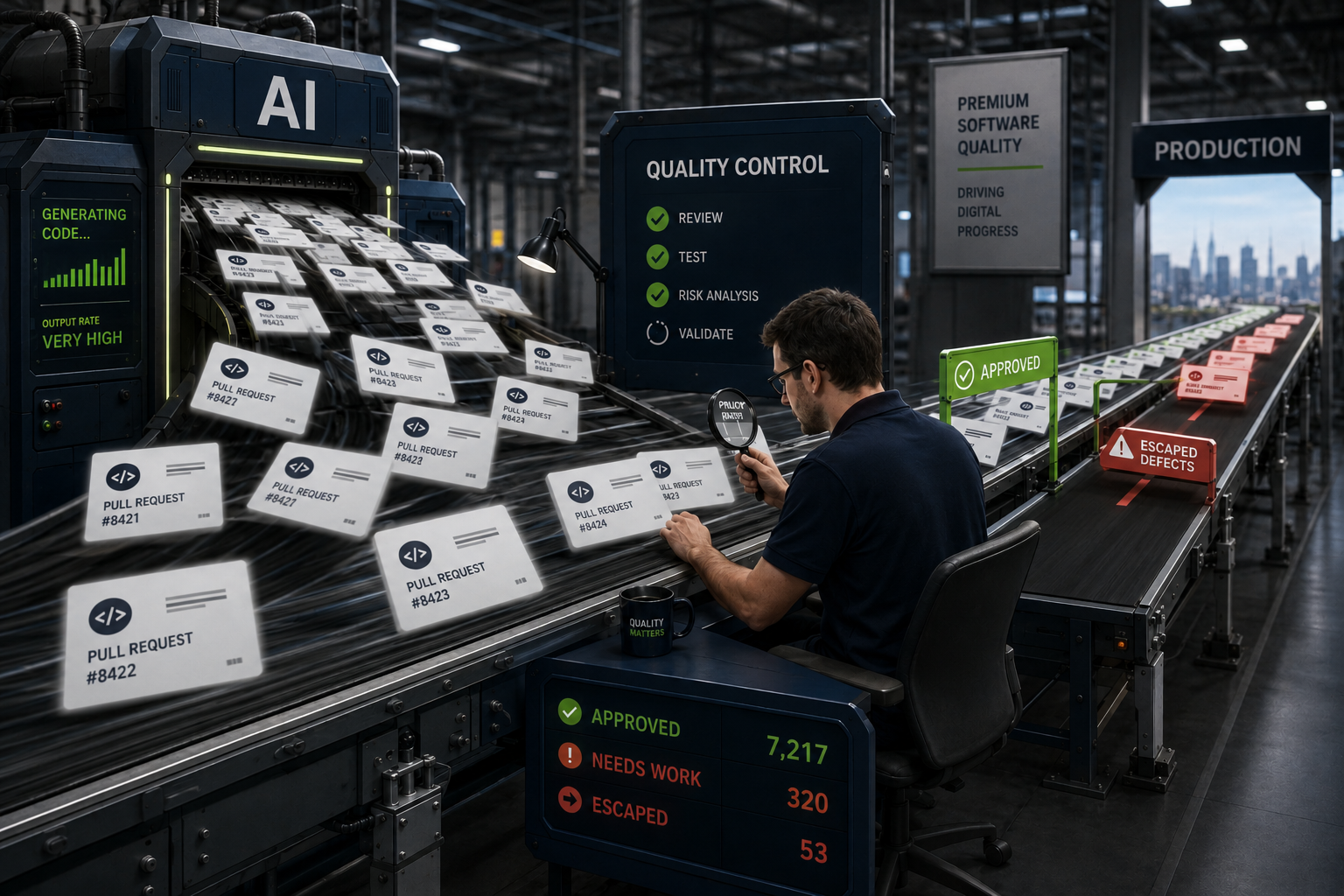
AI enables us to write code faster than we can review it.
The most common response to that problem is to buy more tools. But anyone who examines both assumptions closely will discover they do not hold up.
This article unpacks that double misconception: the paradox of speed, and the reflex that makes it worse. It also shows what actually works.De paradox
The paradox
Most defects appear in recently changed code. We’ve known that for years.
What is new is that AI is increasing the volume of changed code faster than teams can keep up with. Pull requests are growing. Review cycles are getting shorter. The number of escaped defects is demonstrably increasing.
And it doesn’t stop at functional errors. AI-generated code also introduces security and compliance risks that nobody has explicitly reviewed: data leaks, requirements under the EU AI Act, and behavioral assumptions that were never validated.
The 2024 DORA report makes this tangible. The research program has been running for ten years and gathered input from approximately 3,000 professionals this year. AI adoption leads to higher individual productivity, but also to a measurable decline in release stability. The report’s conclusion is clear: fundamentals such as small batch sizes and systematic testing remain indispensable.
Delivering faster feels like progress. But code flowing into production unread is not a gain—it is deferred loss.
Teams are standing at a crossroads: either they accept more production incidents as the price of speed, or they reassess who and what truly makes the difference in the quality process.
The understandable reflex
The response from many organizations is predictable: if AI creates the problem, more AI will solve it. A new platform, an additional license, another test automation tool.
However, a study by BCG and researchers from the University of California, Riverside, published in the Harvard Business Review in March 2026, sharpens the discussion with a specific warning: productivity peaks when people work with approximately three AI tools simultaneously. Add a fourth, and output declines. Cognitive switching, continuous output verification, and information overload combine into what the researchers call “AI Brain Fry.”
Another tool demanding attention does not create additional capacity. It creates more friction, disguised as progress.
For quality-focused organizations, that friction is not merely an efficiency issue. It is a structural source of defects. A tired tester juggling more than three AI interfaces will miss things. Not because the platform fails, but because nobody taught the team how to work effectively with what was purchased.
This is not an exception—it is a recurring pattern. A demo convinces management, contracts are signed, and the “rollout” consists of forwarding a login link. That’s where it ends. The tool ends up gathering virtual dust while the team falls back on old habits.
The license is not the problem. The tool is not the problem either.
What is missing is adoption: a team that learns how to work with AI, not a team that merely gains access to it.
Buying a tool is not adoption. That distinction is the entire point.
Where the value lies
As AI generates more and more code, the value of the tester shifts toward what AI cannot provide: leadership in quality within a development team, risk-based test design, critical judgment about business impact, and the ability to challenge assumptions early.
The goal is no longer to review every line. The goal is to determine which lines are worth reviewing.
Testers do not see AI-generated code as a problem. They see it as a goldmine of potential bugs.
Good testing begins where automated generation ends.
A simple example illustrates this. A skilled tester does not read every line produced by AI. Instead, they focus on the places where AI-generated code typically fails: edge cases rather than the happy path that already works.
What happens with empty input? An exception? A scenario omitted from the original prompt?
Those are the moments where AI fills in assumptions that sound convincing but turn out to be wrong.
That is risk-based test design: focusing on where the code is most likely to fail rather than on how polished it appears.
Someone who understands how AI generated that code knows exactly where to look. Someone who only has a login does not.
That distinction lies at the heart of what is at stake.
This knowledge cannot simply be installed. It develops through experience: questioning AI-generated code, observing where it fails, and understanding what those failures mean for the product and the people who depend on it.
Literacy as a force multiplier
At Polteq, we approach this through a two-part strategy.
The first movement is internal: building an AI-driven software quality organization. We use AI as a production instrument. Polteq delivers faster and with greater coverage. The investment is made in the smartest hours, not the cheapest ones. That is what makes the difference when assignments become complex and nobody else knows which questions to ask.
The second movement is external: accelerating software quality with AI throughout the entire software development lifecycle. Polteq supports clients in their own AI adoption journey, from AI-assisted requirements engineering to AI-driven test reporting.
Hands-on, not theoretical.
Organizations that understand how to work effectively with AI themselves are in the best position to help clients do the same.
We are also working on broader challenges such as AI Red Teaming, quality assurance in agentic workflows, and AI Act compliance. But the foundation comes first: a team that knows what it is doing before pursuing further specialization.
Knowledge scales. Licenses do not.
Any competitor can purchase the same tools. Without the human expertise required to validate risks, however, organizations merely scale the volume of their mistakes.
Measuring what matters
There is another mistake that is less visible but just as costly: organizations measure AI success through adoption metrics.
How many people use the tool?
How many tokens are consumed each month?
A more meaningful question is this:
How many escaped defects in your team originate from AI-generated code?
That number is not always available from an existing dashboard. It requires tracking which code was AI-generated and which post-release defects were later discovered in that code.
Teams that do this gain a decision-making instrument that enables targeted choices about training, risk-based test strategies, and the appropriate boundaries of automation.
It is also the metric that reveals where investments are paying off—and where they are not.
Polteq’s vision
Polteq summarizes its vision with a simple image:
Software is like the air in our lungs—so ubiquitous that we barely notice it, yet absolutely essential.
As AI generates more code, we are also breathing in more unchecked software.
The mission that follows is equally concise: delivering Premium Software Quality as a driving force behind digital progress.
Not a slogan on a poster, but the work that determines whether progress endures.
Tools become commodities quickly. Within months of a major release, every competitor has access to the same model, the same API, and the same functionality.
Training does not commoditize.
A tester who masters prompt engineering, develops technical expertise in large language models, recognizes when an AI response relies on unreliable sources, and understands adversarial prompting possesses judgment that cannot be licensed.
That is why education makes the difference—not as a one-time course, but as a continuous process of learning and improvement.
It is one of Polteq’s core values, and AI makes its importance more visible than ever: what was sufficient yesterday may already be outdated tomorrow.
Premium Software Quality is the result of testers who know what they are looking for. Who challenge AI output. Who maintain standards when speed threatens to come at the cost of correctness.
AI literacy makes that capability the standard for an entire team—not just for the individuals who would have figured it out on their own.
Want to know where your organization stands?
That conversation starts with us.
Jorre van Munster
AI Lead and Test Specialist at Polteq